- Is the fig tree here in chapter 24 a parable or something else?
- Does this sprouting of the fig tree occur before, during or after the destruction of Jerusalem?
- What would it be like, to be in the Lord's summertime?
- Do fig trees always behave in this manner, sprouting leaves and so forth? How does that help Jesus form the Twelve?
 Jesus is the Lord, the Alpha and the Omega. All time and all the ages belong to Him. Yet how is it that Jesus does not know the hour and day of His coming to the gates?
- "A person who is damned to hell is damned because of the entire history of his entire family." ←← True or false?
- "A person who is damned to hell can actually be damned accidentally, through no fault of their own." ←← True or false?
- "Hell is temporary." ←← True or false?
- In America, we hold that all men are created equal. Does this apply to the talents that each man has?
- Why does God give talents in the way that He does?
- When you enter God's joy, what will you be placed in charge of?
Showing posts with label gospel. Show all posts
Showing posts with label gospel. Show all posts
Tuesday, February 28, 2012
Finish ch. 24, dip forward to ch. 25 of Matthew's gospel.
We will take one more look into chapter 24 of Matthew's gospel early this Thursday morning, and then we will dip forward to chapter 25. Here are a few questions to use for studying and thinking ahead:


Thursday, May 27, 2010
Late questions for early morning

Image: Blue Spring, Florida
We will consider again this week the interesting analogy James constructs comparing body and spirit, faith and good works. And then onward into chapter 3 we will spend time thinking and discussing these questions:
- In v. 11, James mentions water that is pure and water that is brackish. In the gospels, Jesus uses the image of water in his teachings, too. What does Jesus teach about using the image of water?
- James does not recommend that one must keep his mouth shut. Instead, what does James recommend for handling the power of the tongue?
SNEAK PEEK: Does the first verse of chapter 4 have anything to do with the James' admonitions about the power of the tongue?
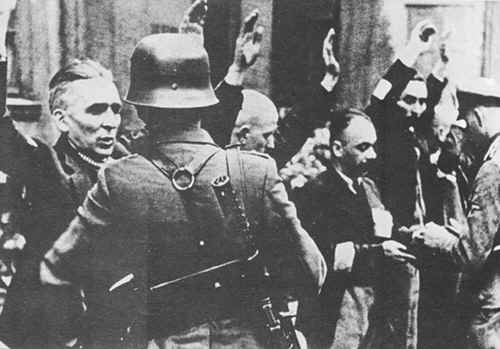
Image above right: Gestapo roundup, WW II [Courtesy of the Holocaust Education & Archive Research Team www.HolocaustResearchProject.org]
Wednesday, January 13, 2010
Questions for next time
We will finish the reading of Mark's gospel tomorrow, considering the 16th chapter. There is only one question to discuss:
- This conclusion to Mark's "lecture notes" for the school of evangelism, how does it affect the mission of the apostles? Especially, what does it say about our mission?
Thursday, January 7, 2010
Some vocabulary
In the Greek manuscript, there are several interesting words:
- The inscription on the cross contains the word ΒΑΣΙΛΕΥΕ -- in our alphabet, BASILIYE. It means "king," and is related to our word basilica and to the proper name Basil.
- εγκατελιπεs, which is translated "forsaken," and which ancient Greek writers also used at times in the sense of being left behind in a race.
- εξεπνευσεν which is translated "expire" for the moment of death. In our alphabet you could write it exepneusen, and you can see the prefix "ex-" meaning out, and the root word "pneuma" which we use to indicate air, as in our word pneumatic but which the Greek speaking world also used to denote the spirit. E.g., the Greek words for Holy Spirit include πνευμα.
Wednesday, January 6, 2010
Questions for next time
 Before Christmas, we considered the trials of Jesus before the Sanhedrin and before Pontius Pilate. We looked into the actions of Simon of Cyrene carrying the cross for a while. Now we will look into the death of the Messiah. Here are some questions to think over as you prepare and read this week:
- DOUBLE QUESTION: When Jesus was crucified, two groups mocked him on the cross.
- How do the passers by mock Jesus?
- How do the chief priests and scribes mock him?
- Why did the bystanders say, "Wait!" as they stood by the crucifixion place?
- Between verse 29 and verse 39, how do the statements of passers by and bystanders change?
- Why were Mary et al. standing far off?
- What is peculiar about the two sentences about Mary et al. in the verses 40-47?
Thursday, December 17, 2009
Envy
 In Mark's fifteenth chapter, verse 10, we read,
 For he knew that it was out of envy that the chief priests had handed him over.Why envy? Why does Mark feature this fault in the αρχιερειs, the chief priests, and not some other fault? Some of the insights from men:
- Dave: the chief priests were envious because they were losing adherents.
- Jim: they envied Jesus because Jesus had answers -- they didn't.
- German: It was because God the Father was with Jesus. German compared the situation to the parable of the prodigal son, especially the elder, faithful son, who was envious of his father's generosity to the prodigal son. It is a good comparison, one shared by another German, Pope Benedict!And what of the elder brother? Is he not, in a certain sense, all men and women as well; perhaps particularly those who sadly distance themselves from the Church? ...Unable to think beyond the limits of natural justice, he remains trapped within envy and pride, detached from God, isolated from others and ill at ease with himself.
- Sal: Envy goes along when pride starts to move. It is like the enemy falling through the sin of pride, compared to the Messiah who won the victory in humility. For God formed man to be imperishable; the image of his own nature he made him.
But by the envy of the devil, death entered the world, and they who are in his possession experience it.
Tuesday, December 15, 2009
Questions for next time
When we dive into the fifteenth chapter of Mark's gospel, we can consider some of these questions.
- Why does Mark immediately emphasize the time of day, early morning, in the very beginning of this section?
- Why were the soldiers so careful to remove the purple garments from Jesus before leading him out of the Praetorium?
- How does Pilate's questioning compare to the temptations of the enemy at the beginning of Jesus' open ministry?
- What is the distinction of Simon of Cyrene on this day?
- Why did Jesus stay hushed in the middle of this trial?
Thursday, December 10, 2009
Peter and Jesus
 We discussed the betrayal event again this morning, especially what Peter's actions mean for us in this day -- his sleeping, his denying Jesus, and later events.
- Bob: This is the test of Peter, but he did pass the test. He must have thought, "What a coward I was!" But later on, BANG! He became the strong central apostle.
- Sal: This is the time of building for Peter's character. God builds our character through our mistakes.
- Joe: The Lord works it in such a manner because he knows that Peter will eventually become the man the Lord wants.
- German: God is always ready to give us another chance.
- Deacon Alfonsus Magnus: Peter's path is an example of God's love and mercy... especially mercy.
We discussed the prayer in the garden of Gethsemane, and the unusual state of God praying as a human for strength. In this, there were additional comments:
- German: it was like a man going off to combat, worries but determination.
- Scott: As men, we want to work and not rely on anybody. But Jesus trusted the Father.
We also talked about Joseph, faithfully working and teaching his son, yet every day trusting his life and the life of his family to God the Father. Good.
Wednesday, December 9, 2009
Questions for next time
Next time we will dive deep into Mark 14:43-72. Here are some questions to consider as you read and prepare:

- Was Jesus surprised that the betrayer Judas and the crowd nabbed him this night?
- What was it that Jesus said that caused the high priest to tear apart his clothes and cancel his subscription the Jerusalem Slantinel?
- Was Peter's performance under questioning by the slave girl the same as or different from Jesus' response to the questioning of the high priest?
- If this gospel is really Peter's gospel written up by Mark in Rome, as many commentators think, then what does Peter the bold apostle gain by blabbing up this sorry moment in his history? How does it help him build up the faith of the newcomers to his flock?
- Who was the young man mentioned in verses 51 and 52?

Our blessing cup
We studied the psalms that Jesus sang with the Twelve on that Passover evening, especially Psalm 116, "I will raise the cup of salvation and call on the name of the LORD."
The Church teaches that the obedience of Jesus in this Passover is all.
And to this day, we still sing Psalm 116 on Holy Thursday, just like the Messiah and the Twelve did.
The Church teaches that the obedience of Jesus in this Passover is all.
The obedience of Jesus has transformed the curse of death into a blessing.
And to this day, we still sing Psalm 116 on Holy Thursday, just like the Messiah and the Twelve did.
Thursday, December 3, 2009
The betrayal event
This morning, we discussed the emphasis on the cup of salvation in Mark 14:22-25, and how Mark devotes so many more words to it than he devotes to the one bread. After looking through Psalms 116 and 118, and re-examining the passages before and after Mark 14:22-25, we decided that Mark was emphasizing the cup in the middle of the betrayal event, all the betrayal and abandoning and the difficult prayer in Gethsemane.
It is curious that Jesus can sing the psalms of praise, the Hallel psalms, Psalms 113-118, in the midst of such a trap. Yet that is exactly what he does, the sacrifice of praise. The stone that was rejected became the cornerstone.
German describes an example in the life of St. Vincent de Paul, concerning a similar sacrifice in the midst of abandonment and betrayal.
It is curious that Jesus can sing the psalms of praise, the Hallel psalms, Psalms 113-118, in the midst of such a trap. Yet that is exactly what he does, the sacrifice of praise. The stone that was rejected became the cornerstone.
German describes an example in the life of St. Vincent de Paul, concerning a similar sacrifice in the midst of abandonment and betrayal.
Monday, November 23, 2009
Jesus the Lamb
We discussed the plan of God the Father that the promised Lamb should be sacrificed in the Passover that year, recorded by Mark in his gospel. It was a promise long time coming.
Thursday, November 19, 2009
Judas
Further reading is required for this unanswered question:
- Was Judas present all the way through the Last Supper? Or did he go out before Jesus broke the bread and shared that last cup?
So we have some homework for next week. Good.
Wednesday, November 18, 2009
Prepare for next time
 We will dive into chapter 14 of Mark's gospel this Thursday morning. Here are some questions that can guide your reading.
- Who wanted the death of Jesus to occur during the feast of unleavened bread?
- Who wanted the death of Jesus to occur before the feast of unleavened bread?
- Which of the Twelve wanted three hundred denarii for the poor and did not want Jesus to be anointed with the expensive Nardostachys grandiflora "spikenard" ointment?
- Jesus had a plan for the first day of unleavened bread. How did his plan begin?
- What is the significance of Jesus knowing who his betrayer is?
Sunday, November 8, 2009
Questions for next time
 We will continue into chapter 13 of Mark's gospel with some of these questions:
- No man knows the hour, only the Father, when the Son of Man comes in the clouds with great power and glory. Is it kosher for Jesus to not know this hour and day?
- There is another comparison to a man away from home and the behaviors of the servants while the lord of the house is away. What other parables in Mark have used a similar story?
- Through Mark's record, Jesus admonishes us to be alert, even in the night. How is it that each member of the Church can be alert? What is the meaning of this alertness? Or, what is the meaning of sleep, about which Jesus cautions us?
What is the sign? What is the σημειον?
The section of Mark's Gospel 13:1-31 is loaded with meaning, since it is the reply of Jesus to the Twelve, who asked, "What is the sign that these things are about to come to an end?"
Many people attempt to nail down the identity of the nausea from the desert that stands where it ought not stand. Could it mean King Herod from Red Edom? Could it mean Adolf Hitler, Anwar Sadat, Michael Gorbachev or the eagle atop the standard of a Roman legion? We agreed that the main lesson in this regard is quite clear, the very first words spoken by Jesus here: "Take heed that no man deceive you!"
The meaning of some of these words comes into view if we look over the Greek words and how the Greeks used them, and if we find that they connect to any familiar words in English. Here is a list of a few of the vocabulary terms.
- σημειον, semeion, has a variety of uses for an ancient Greek:

- mark by which something is known
- sign
- signal made of flags
- landmark for property boundaries etc.
- device upon a shield, like the shield held by the Greek soldier on the ancient Greek vase, at right.
- watchword
- in reasoning, it meant proof
- symptom
- in mathematics, a geometric point in time.
- εγω ειμ, ego eimi, literally, "I am." In v. 6, Jesus warns against those who say this, a phrase with intense meaning for the Jews. Cf. Exodus 3 for the story of Moses and the Lord at the burning bush, where the Lord reveals his name to Moses.
- πλανησουσιν, planesousin, meaning to lead astray, wander. We have an English word, planet, based on this Greek word. The planets are not fixed in the night sky; they wander. E.g., Venus is sometimes visible as a morning star, sometimes as an evening star.
- σεισμοι, seismoi, meaning earthquakes. We have an English word for earthquakes: seismic.
- μαρτυριον, marturion, meaning witness, testify. Our language has the word martyr from this Greek usage.
- βδελυγμα, bdelugma, meaning abomination, a Greek word for which I know no connecting English words. In Greek usage, it means nauseating, filth, or coarse, beastly behaviors.
- ερημωσεωσ, eremoseos, meaning desolation. In Greek usage, it is a word for isolated, "of the desert," or "in the wilds." Mark uses this concept a few times in chapter 1, for instance. English derives hermit from this Greek root.

Many people attempt to nail down the identity of the nausea from the desert that stands where it ought not stand. Could it mean King Herod from Red Edom? Could it mean Adolf Hitler, Anwar Sadat, Michael Gorbachev or the eagle atop the standard of a Roman legion? We agreed that the main lesson in this regard is quite clear, the very first words spoken by Jesus here: "Take heed that no man deceive you!"
Wednesday, October 28, 2009
Questions for next time
At our next meeting, we will read the message in Mark 12:18-48. This part of the message is loaded with meaning for the mission of the Twelve and for our mission.
We will tackle the Temple activity of this part of Mark's gospel and consider our own actions through these and other questions on Thursday morning before sunrise.
- To disprove the resurrection of the body, the Sadducees try to trip up Jesus with a contrived example based on the Torah. Does Jesus answer by saying Moses and the Torah are wrong?
- The wise scribe went toe-to-toe with Jesus about the heart of the Torah. Who won, Jesus or the wise scribe?
- What else does Psalm 110 say about the Messiah?
- Jesus and the Twelve observe a widow as she drops some coins into the treasury of the temple, for alms. How does her example jibe with the the message of the fig tree, the parable of the vineyard owner's son, and the overall message that the Twelve must eventually publish far and wide?
We will tackle the Temple activity of this part of Mark's gospel and consider our own actions through these and other questions on Thursday morning before sunrise.
Saturday, October 24, 2009
Hic est hæres
 There are several kinds of greetings to the Messiah, coming to Jerusalem, both actual greetings and greetings in a parable:
- Bartimaeus, outside Jericho: Jesus, Son of David, have mercy upon me.
- General crowds at the gates of Jerusalem: Hosanna!
- Tenants in the parable of the vineyard: "Hic est hæres," Here is the heir, let's kill him.
It is a somber comparison, because we also know EXACTLY who this last one is, the only Son of the Father. Are we closer to good and faithful Bartimaeus or to the wicked tenants in the parable?
Tuesday, October 20, 2009
Questions for next time
We will study the Messiah's saying about authority and his parable about the vineyard. Here are some questions to think over.
We strive toward the Lord's heart, and seek the Lord's wisdom in Mark's gospel, through these and other questions on Thursday morning this week.
- What did Jesus do or say that lead the chief priests, scribes and elders to question the authority of Jesus?
- Was there another incident in Mark's gospel where "the man" questions the authority of Jesus?
- What does Isaiah 5:1-7 tell you about the heart of the Messiah?
- Does the parable of the vineyard teach further along the same road as the fig tree?
We strive toward the Lord's heart, and seek the Lord's wisdom in Mark's gospel, through these and other questions on Thursday morning this week.
Thursday, October 15, 2009
Subscribe to:
Posts (Atom)
 We have an informal Bible study at 7:00 AM, every Thursday for the men of the
 Posts
Posts


