Showing posts with label James. Show all posts

Wednesday, August 15, 2012

A few questions in James 3

This chapter concerns how we use our tongue to speak, and the nature of our words. Here are some questions we might begin with:
  1. A teacher, to James, is a person who primarily communicates by ______. (multiple choice)
    1. his spoken word
    2. his YouTube account
    3. his writing
    4. artwork and sculture
    5. Chuck Norris concepts
  2. The tongue of a man is compared to a horse's bit and to a teeny rudder. What part of a man fulfills the analogy of the reins by which the rider controls the bit?
  3. Continuing the analogy: What part of a man compares to the ship's wheel?
  4. Completing the analogy: who or what is the rider of the horse, the captain of the ship?
  5. Did Job ever have occasion to sin with words from his mouth? How about Moses?
  6. Read Psalm 19. How does the final verse jive with James' teaching in chapter 3?
  7. In v. 11, James mentions a spring of pure water. What should be the source of our pure words?
  8. Can a person dip into jealousy or selfish ambition without some unwise spoken words?
  9. How do jealousy and selfish ambition, spoken openly, help a teacher of the Lord's way to lead students toward God?

We will start with these questions on Thursday morning, a lot to learn.
Thursday, August 9, 2012

James 2

Questions for chapter 2 of James:
  1. Why are good works an essential part of Christian faith?
  2. James remarks in v. 19 that even the demons believe. What does that mean for a Christian who seeks to be obedient to God?
  3. If faith without works is dead, then is it similar to bodily death?

Saturday, July 28, 2012

Get going with James 1

Here are some study questions for starting to read in the epistle of James:
  1. In Proverbs, wise King Solomon says that the fear of Lord is the beginning of wisdom. How does the fear of the Lord arise in the soul?
  2. What part of the Our Father jives with the challenge of James, that we ask God for wisdom?
  3. Is a trial, mentioned in v. 2, the same as a temptation, mentioned in vv. 12-14?
  4. Was Jesus ever tempted?
  5. James admonishes us, saying that we must not "test" God the Father, in the sense of asking God to prove Himself. What is this testing? If you are in a trial of some kind, what would you want God to prove about Himself?
  6. The Church teaches that "the family should live in such a way that its members learn to care and take responsibility for the young, the old, the sick, the handicapped, and the poor." Would James have agreed with that?
There is a lot to learn in this beautiful writing. Let's have some coffee on Thursday morning, 7 AM, and then gaze into this perfect Torah of freedom.

Thursday, July 1, 2010

Exam scores

I had to use x-ray vision to read the handwriting of some of those exams, but the scores are IN.

Thursday Morning Men's Bible Study earned an A+ on the James final exam. Nice work.

Tuesday, June 15, 2010

Questions concerning the perfect Law of freedom in the letter to the Hebrews

Our next section of the Bible is the letter to the Hebrews, starting on page 569. It is loaded with wisdom.
  1. Read the opening two verses of chapter 1, "In times past, God spoke..." What parable in the Gospels compare to these two verses?
  2. Now look at the first part of v. 3. Which Gospel begins with concepts like v. 3 of Hebrews?
  3. In v. 4, there is mention of the name. Which letter of Paul has a beautiful passage about the name above all other names, to the glory of God the Father?
We are just getting started! It is going to be a big exciting job to look into this part of the perfect Law of freedom.

But to start the day, we will have a 15 minute final examination on James' letter to us. Bring a pen or pencil and be ready to think.

Wednesday, June 9, 2010

James 5 questions, true or false

Here are a medium difficulty questions to help you wade through the advanced concepts of James 5.
  1. TRUE or FALSE: "James gives rich folks an easy ride, no problems."
  2. TRUE or FALSE: "Sharp business practices are encouraged by James, especially saving money on wages."
  3. TRUE or FALSE: "Jesus will overlook unfairness and will say, Tut, tut! to rapacious dealing when Judgement Day appears."
  4. TRUE or FALSE: "Sins that cry out to God are no great matter, and the following passages of sacred scripture
    1. Genesis 4:10
    2. Genesis 18:20
    3. Genesis 19:13
    4. Exodus 3:7
    5. Exodus 20:22
    6. Deuteronomy 24:15
    7. Revelation 6:10
    can be safely ignored."
  5. TRUE or FALSE: "Praying for a person in trouble is useless and James does not recommend this."
After we get the TRUE/FALSE answers sorted out on Thursday morning, we will discuss why the answers sort out the way they have.

Sunday, May 30, 2010

Questions concerning James 4

We gaze into the perfect Law of freedom, and it is like looking in a mirror. Therefore, to become a doer of the Word, we must attend to our own actions. In this chapter of James' letter, there is one concept repeated: humble yourselves. Here are some questions to help sharpen our view in the mirror:
  1. There are many action words in this chapter: make war, covet, possess and so on. Which of the actions James describes are typical of the enemy that prowls the world seeking the ruin of souls?
  2. In contrast, which of the actions are the actions we see in the great saints like Blessed Charles Lwanga and his companions?
  3. Jesus also lived out many of the actions James describes. Which actions?
  4. Combo question: which of the actions of Jesus and the saints (questions 2 and 3) are absolutely impossible for the enemy to attempt?
  5. How many different works of mercy are there, anyway?
  6. Now that you have looked in the mirror... which of the actions of Jesus and the saints can you improve on in your own life?
See you early on Thursday morning!

Thursday, May 27, 2010

Late questions for early morning

Image: Blue Spring, Florida

We will consider again this week the interesting analogy James constructs comparing body and spirit, faith and good works. And then onward into chapter 3 we will spend time thinking and discussing these questions:
  1. In v. 11, James mentions water that is pure and water that is brackish. In the gospels, Jesus uses the image of water in his teachings, too. What does Jesus teach about using the image of water?
  2. James does not recommend that one must keep his mouth shut. Instead, what does James recommend for handling the power of the tongue?
  3. SNEAK PEEK: Does the first verse of chapter 4 have anything to do with the James' admonitions about the power of the tongue?
Get ready to get down to the nitty gritty with these questions in chapter 3 of James' letter today.


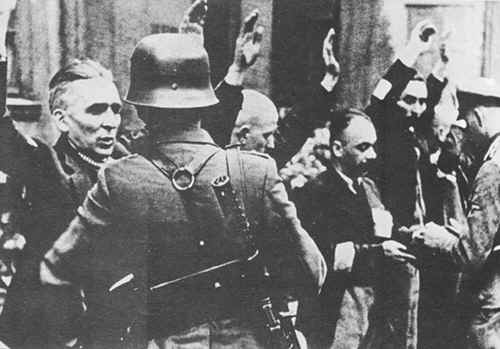
Image above right: Gestapo roundup, WW II [Courtesy of the Holocaust Education & Archive Research Team www.HolocaustResearchProject.org]

Friday, May 21, 2010

How does love comprehend faith and works?

We discussed the relationship between faith and works yesterday morning. Here is a short discussion that wraps it up well.

Wednesday, May 19, 2010

Some questions in chapter 2

Berlin airlift, 1948

We are gazing into the perfect law of freedom, God's Word. Here are some questions to get you thinking more about this part of James' letter.
  1. Can one truly be a doer of the Word if one plays favorites?
  2. James talks about words and actions. Other people can be deceived by words, but can God be deceived?
  3. James writes in v. 26 about body, spirit, faith and works, viz.
    For just as a body without a spirit is dead, so also faith without works is dead.
    Do you notice anything unusual in this double comparison?
We will dig into God's Word early this Thursday morning, starting with these questions, but let's also be open to God's direction elsewhere if necessary.
Berlin Wall sei verschwunden, 1989!
Berlin wall is down, 1989

Findings

One of our questions last time was, "Which sentence in this chapter would be a good place to start a prayer, a needed prayer, in our parish?" Each of the men had an answer. Here is a rundown:
  1. Carry on the Word -- hard to do with so many temptations to do the opposite.
  2. Be doers of the word and live it out. Be honest. Because the mind can stray even in the middle of prayer.
  3. Being religious is a 24-hour job, especially taking care of widows and the poor.
  4. Free will must be harnessed, because it's pride vs. humility.
  5. Persevere.
  6. This letter is catholic, basis for moral law everyone ought to follow.
  7. It's an exhortation, direct orders, to the leaders in the church of James' day.
  8. The Word is implanted. Live these words!
  9. You hear the Word by choice, so be what you say you are.
It would be an interesting exercise to map these nine prayer concepts into the eucharistic prayer and the other parts of Mass.

Sunday, May 9, 2010

Questions for Thursday

The letter of James is loaded with practical information if you want to build on the solid rock. Here are a few specs concerning James:
  1. The author is James, not the brother of blessed John, but the James who was a shirt tail relation to Jesus and became the first bishop of Jerusalem, whom Dr. Luke describes in Acts 15.
  2. The letter is informally classified as a catholic epistle -- i.e., addressed to all churches. Yet it does contain an exhortation a bit like the exhortation to the Smyrna church in Revelation. It is a big maybe, though, because there were probably loads of churches who needed this letter's exhortation.


Here are a few questions to work with when reading ahead into the first chapter of James' letter:
  1. Joy. Wisdom. Trials. Faith. Crown of Life. So many concepts, and it is just the first chapter! Which sentence in this chapter would be a good place to start a prayer, a needed prayer, in our parish?
  2. Have you ever experienced joy DURING a trial or trouble? (Note: we have asked this question before. )
  3. What geographic locations would be considered to be part of the dirspersion? Which locations would not be considered to be part of the dispersion?
  4. Is there another place in the New Testament that combines the concepts of our birth, first fruits and creation, as James does in v. 18?

Let's work with these questions on Thursday morning, as we gaze into this part of the perfect law of freedom, God's Word

Jude and James

We read the letter of Jude this past Thursday, with its exhortation concerning faith. Jude asked the church to ignore the scandalous actions of a small group of interfering men, and build on solid rock with actions that show faith, such as the works of mercy.

This is entirely consistent with the Messiah's own message concerning the fig tree, which we studied in Mark's gospel recently. German, Ken, Len, Scott and Joe have a good explanations. Here are Ken, Scott and Len:


On Thursday, May 13, we will start studying the letter of James.