Showing posts with label prophets. Show all posts

Thursday, March 24, 2011

Questions for this Thursday

We will go into a few questions from last week, viz.
  1. How is the intention of the magi, to worship the newborn king (verses 2, 11), different from Herod's similarly stated intention?
  2. In v. 13, Herod sets out a plan to destroy the innocent children near Bethlehem, but re-read Rev. 9:1-11, where another king has the name of Destroyer. How did people suffer when that destroyer in Revelation went to work? Was its intention similar to Herod's?
...because we have hardly talked about Herod yet.

Also, we will probably dip into chapter 3 this week, for which a few extra questions might be reasonable:

  1. John the Baptist had a diet of locusts and honey. It is a curious menus and a curious symbolism in that the Bible uses honey and locusts in very different ways. What does honey signify in the scriptures, usually? What do locusts usually signify in the scriptures?
  2. What does John the Baptist look for in his flock of Israelites?
  3. When was the last time God raised up a human being from a stone?
  4. What does it mean to the people flocking to the Jordan that the axe is laid to the root of the tree?
  5. What does it mean to bear a winnowing fan by the threshing floor?
  6. What does it mean to be baptized with the Holy Spirit?
  7. What does it mean to baptized with fire?
  8. What does Jesus' statement in v. 15 tell you about his relationship to John the Baptist and his relationship to the Torah?
As you can see, there are some big ideas in this part of Matthew's gospel, and this is just a short list, but we will start here on Thursday morning!

Thursday, February 24, 2011

We conclude Amos.

In Amos' 9th chapter, we still have a few questions to settle, viz.
  1. From last time: Which is the greater trouble, earthquake or famine of God's word?
  2. The LORD denied the promised land an entire generation of Israelites after they exited Egypt. How does Israel's murmuring in Amos 9:10 compare to their attitude in Exodus?
  3. In v. 11, we see the word "breaches" in a wall. What would be the breaches in the Church?
  4. Is the nation of Israel doomed?
  5. How is the prophecy of Amos applicable to our present situation?
Let's sort these out and dive into the perfect Law of freedom this morning.

Wednesday, December 29, 2010

We look into the prophecy of Amos

For the next two months we will dive into the prophetic message of Amos. This Thursday we will look over chapter 1, for which the following questions might come in handy:
  1. According to verse 1, the message to Israel came in visions. How is it that Amos saw this message in a vision? What did Amos see?
  2. The time of Amos' message was sometime during the years 783 - 743 B.C., approximately one hundred years after Elijah, two hundred years after David, 500 years after the Exodus, and 1100 years after Abraham. Who were our cultural forebears
    1. one hundred years ago, about 1910 A.D.?
    2. two hundred years ago, about 1810 A.D.?
    3. five hundred years ago, about 1510 A.D.?
    4. eleven hundred years ago, about 910 A.D.?
  3. What kind of terrain was Mount Carmel, mentioned in v. 2?
  4. The words of verses 3 - 15 contra Damascus, Gaza, Tyre, Edom and Ammon mention threshing sleds and fire falling on cities. In what other parts of the Bible have we studied threshing and fire troubles?
  5. Where is Edom? Where is Ammon? Are they near Tyre and Sidon?
Let's look into these questions on Thursday morning, with the expectation that they will help us become doers of the Word.

Image: a threshing sledge from Cyprus.

Thursday, December 23, 2010

Conclusion of the matter

Here are some of the comments and conclusions from this morning's Bible study session, question by question.
  1. The Lord considers Nineveh a bloody city. Is there any city on Earth today that you consider to be a bloody city? Is it like Nineveh?
    1. Len: Amsterdam, New Orleans, San Francisco for debauchery, which the prophet Nahum mentions in the same breath as blood.
    2. Scott: Hating an entire city is like what terrorists do.
    3. Bob: Mexican border cities, overrun by murder by drug lords and criminals.
    4. Scott: Somalia is a lawless place, where life means nothing.
    5. Dave: Cambodia during the Khmer Rouge regime.
    6. Joe: the bloody description of Nineveh reminds one of Civil War battles, line after line of men charging the merciless guns.
  2. How can a nation like Assyria enslave another nation by prostitution? What kind of prostitution would that be?
    1. Ken: prostitution in this case is like the Nazis recruiting collaborators in France by selling access to their military and political power.
  3. Same question, regarding witchcraft: What kind of witchcraft can enslave a nation and end with bloody subjugation?
    1. Ken: Like being spellbound by government handouts and giving credence to the government's every pronouncement.
    2. Ken: Being spellbound by moral relativism, as mentioned in Abolition of Man, by C. S. Lewis.
  4. How does this prophecy of Nahum relate to our lives today? What does it make you feel?
    1. Bob: It makes me want to pray more.
    2. Scott: Be like Rachel's Vineyard.
    3. Joe: Be like Tobit, practicing the works of mercy.
Joe's conculsion to the matter makes a lot of sense.

More questions -- but can you answer them?

We study Nahum's prophecy, the third chapter. Here are some questions to consider:
  1. The Lord considers Nineveh a bloody city. Is there any city on Earth today that you consider to be a bloody city? Is it like Nineveh?
  2. How can a nation like Assyria enslave another nation by prostitution? What kind of prostitution would that be?
  3. Same question, regarding witchcraft: What kind of witchcraft can enslave a nation and end with bloody subjugation?
  4. The prophetic word compares the ruin of Nineveh to what action in verses 5 and 6?
  5. Does the Lord expect Nineveh to get a dose of its own medicine, regarding its earlier conquest of No-ammon a.k.a. Thebes on the the Nile?
  6. How does the last verse, 3:19, relate to the book of Tobit?

Inscription of Assyrian king Sargon II, describing a conquest after which he flayed the skin of the conquered governor, Assur-Lei.

We will take a walk through these questions, and see whether the perfect law of freedom, God's word, can speak clearly in this our day and help us become doers of the Word.

Wednesday, December 15, 2010

Justice

One of our questions last week was about God's vindication:
  1. We know that Nahum prophesies about Nineveh -- but not in chapter 1. How does the Lord taking vengeance in general -- e.g., Nahum 1:2 -- bear on the situation in Nineveh?

Len had this to say in answer: The Lord works His justice from time to time and will do so again.

This is a good way to view this part of Nahum's message. It jibes with the general jobs of the true prophet, to speak a prophetic word from the Lord and sometimes to predict things to come.

Thursday, December 2, 2010

Conclusion of Tobit

As we study through the last two chapters of Tobit, here are some questions to look into:
  1. What geographical/political fact does Tobit keep referring to in the long prayer, chapter 13?
  2. Tobit concentrates upon Jerusalem in his long prayer, too. Why?
  3. How does Psalm 126 jibe with Tobit's blessing, chapter 14, especially v. 5?
  4. What prophets had messages concerning Nineveh?
  5. Does the book of Tobit tell you anything about the Eucharist or the Cross?
Let's work on these questions, and seek the wisdom of God's perfect law of freedom this first Thursday of December, 2010.

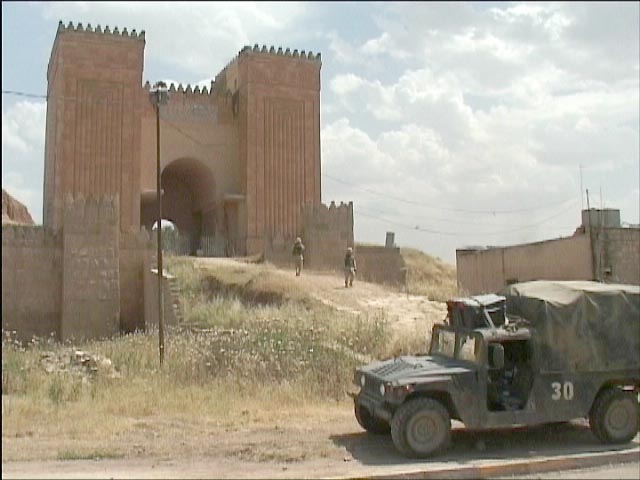
IMAGE: U.S. Army at a reconstructed gate of Nineveh